
A season for foraging
What's in YOUR mug?

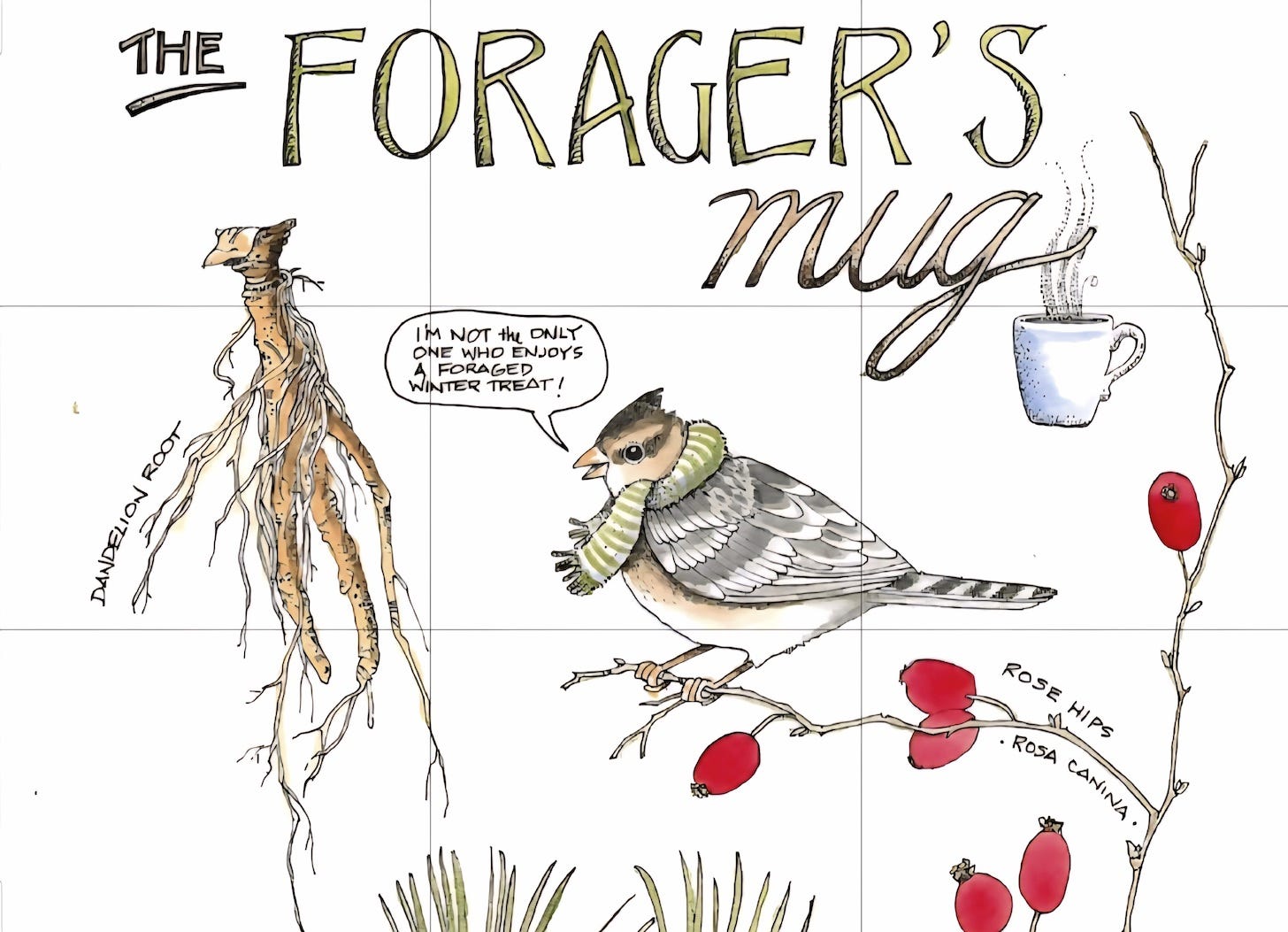
Gradually, a northern winter’s cold grip chokes off all sources of nourishment needed by members of the plant world. Rains slow, and then stop. The upper layer of soil freezes. Days are short, offering little life-giving sunlight. Low temperatures stop the flow of sap between roots and leaves.
Each plant has its own way of surviving the bitterest months. Deciduous trees and shrubs surrender their leaves and become dormant. Conifers such as pine and fir have waxy needles adapted for winter, allowing them to continue photosynthesis for part of the season. Compared to leaves, their darker blue-green color can absorb some energy from weak winter sunlight... for a time. Their growth finally stops, but evergreen foliage is rich with stored vitamins that provide foraging animals with much-needed nutrients in the coldest part of the year. Annuals can’t survive winter at all, but their seeds can. These flowering plants produce a wealth of seeds and seed pods during autumn, each protected in a tough coating. Perennials use the insulating properties of snow to survive, dying back to their well-nourished roots to pass the winter tucked cozily underground.
Winter wildlife can feed on these nutrient-dense seed pods, roots and needles.
People who enjoy foraging for wild foods can enjoy them, too, especially in the form of hot beverages. Rose hip tea is a delicious source of Vitamin C.
Dandelion roots can be chopped, roasted and ground to create a coffee substitute robust with potassium, Vitamins A and C, calcium, iron and manganese.
Pine needle tea is mostly an acquired taste, but contains four times the Vitamin C of lemons. Early settlers used it to prevent scurvy during long winters in the New World. Historically, the tea is made from white pine (Pinus strobus) since several varieties of conifer including Norfolk pine, ponderosa pine and yew can be toxic.
I’m still new to foraging. I’m also very cautious, so I’ve mainly sampled the wild plants that were already familiar: chopped chickweed added to my veggie sandwiches, Canadian wild lettuce in a salad, a cup of steaming tea made from purple dead nettle. This spring, I plan to try the scary-looking but reputedly delicious bristle thistle that pops up in the open grasslands near my cabin. Anyone have a good thistle stir fry recipe?

I love my wild foraged teas! Currently sipping a cup of Fireweed and Wild Mint :)
I don't know where in Canada you are, but if you have Fireweed there - I highly recommend giving 'Ivan Chai' a try!
I love this Val. Thank you for sharing this. Foraging is so interesting. I’m not active with it as so many places here in Ontario 🇨🇦are private. I took a foraging workshop a few years ago with a lady named Karen Stephenson. She has a website called Edible Wild Food. She has some recipes and info that you may be interested in.
And botanical artist Wendy Hollender illustrated a lovely book called Foraging and Feasting: A Field Guide and Wild Food Cookbook.